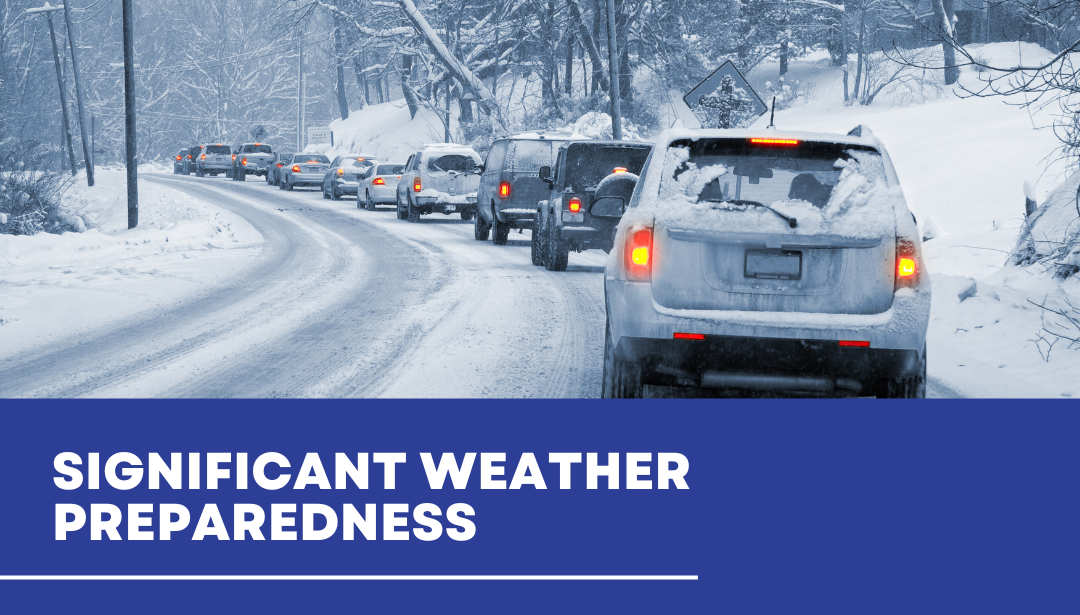
Significant Weather

Declaration of a Significant Weather Event

Peterborough County may declare a significant weather event following a weather alert issued by Environment Canada per O. Reg. 239/02 MINIMUM MAINTENANCE STANDARDS FOR MUNICIPAL HIGHWAYS | ontario.ca section 4.1.  During a significant weather event, residents are advised to use caution and are reminded that winter maintenance service levels for roads may not be met.

A significant weather event is defined as an approaching or occurring weather hazard with the potential to pose a significant danger to the users of highways within a municipality. When hazardous weather is expected, Environment Canada will issue an alert under its Public Weather Alerting Program. 

Peterborough County wishes to note that the declaration of a significant weather event only addresses the timelines and does not reduce the standard level of service provided. The declaration is to notify the residents of Peterborough County, that due to the current forecasted conditions, caution is to be exercised when travelling on County maintained roads and to drive according to road conditions until plows have serviced them.

It is prudent to be ready by creating an Emergency Preparedness Kit.

If a severe storm is forecast, secure everything that could be blown loose, both indoors and outdoors. Flying objects like recycling bins and lawn gnomes can injure people and damage property.

  • If you live in a blizzard-prone or snowy area, ensure your emergency preparedness kit includes extra heating fuel and ready-to-eat foods
  • Maintain your property by cutting down dead trees and branches to reduce the danger of these falling onto your house during a storm. Check the drainage system around the house to reduce the possibility of basement flooding after a heavy rain
  • When a severe storm is on the horizon the Environment Canada issues advisories, watches, and warnings through their Weather Information site
  • If hail is forecast, you may want to protect your vehicle by putting it in the garage
  • In the case of a severe thunderstorm, unplug radios and televisions – listen for weather updates on your battery-powered or crank-powered radio

Special Weather Statements

Issued for weather events that are unusual, cause general inconvenience or public concern, and cannot adequately be described in a weather forecast.

Watches

Issued when favourable conditions exist for a possible summer or winter storm. In the summer, a watch is issued up to 6 hours before a storm. In the winter, a watch can be issued up to 12-24 hours in advance.

Warnings

Issued when severe weather is happening or will happen. Severe summer storm warnings may be issued less than an hour in advance of the storm.
Take warnings seriously! Seek shelter and prepare to activate your emergency plan.

Remember: Never cross a flooded area

Reduce the chance of flood damage by:

  • Applying weather protection sealant around basement windows and the base of ground level doors 
  • Install downspout drainage at a sufficient distance away from your residence to ensure that water moves away from the building 
  • Consider installing a sump pump and zero reverse flow valves in basement floor drains

During a Flood:

  • Shut off the electricity
  • If the area around the fuse box or circuit breaker is wet, stand on a dry board and shut off the power with a dry wooden stick
  • Try to move furniture, electrical appliances and other belongings to floors above ground level 
  • Disconnect eavestroughs if they are connected to the house sewer

Flood Classifications

  • FLOOD ADVISORY: notifies that the potential for flooding exists within specific watercourses and municipalities.
  • FLOOD WARNING: notifies that flooding is imminent or occurring within specific watercourses and municipalities.
  • FLOOD SAFETY BULLETIN: notifies that unsafe lake, river and channel conditions exist.
  • WATERSHED CONDITIONS BULLETINS: notifies of anticipated watershed conditions

Tornadoes are formed suddenly, often preceding very warm and humid weather. Typically, they are accompanied by very dark skies, thunder and lightning as well as sounds of rumbling and whistling.

During a Tornado

  • Go to the basement or take shelter in a small interior ground floor room such as a bathroom, closet or hallway.  
  • Stay away from windows, outside walls and doors. Do not use elevators
  • If you are driving and happen to notice a tornado in the distance, try to get to a nearby shelter. If the tornado is close, get out of your car and take cover in a low-lying area.

Did You Know?

Ontario averages about 11 tornadoes per year. On June 23 2010 an F2 tornado hit Midland, Ontario causing property damage of up to $15 million, fortunately only minor injuries were reported.

Windstorms and down bursts can sometimes cause as much damage as a tornado. This severe weather should be taken seriously.

Potential dangers in a windstorm:

  • Debris and falling trees cause severe damage to buildings and vehicles, and can cause fatalities.
  • Fallen power lines can cause widespread power outages.
  • Garage doors are the weakest link in the outer structure of a house. Exterior load bearing walls of buildings can fail, which results in the collapse of the roof.
  • Loose window frames are especially vulnerable during severe windstorms.
  • Light metal buildings, such as garden sheds, can collapse completely.

What to do during a windstorm:

  • Remain calm.
  • If you are inside, move away from windows and exterior walls.
  • If you are outdoors, move into a safe building and avoid downed power lines.
  • If you are driving, pull off the road and stop away from trees and power lines. Avoid overpasses. If possible, walk quickly into a safe building.

Microburst: a downward burst of wind that can causes severe damage similar to a tornado.  

Did You Know?

Windstorms and microbursts can sometimes cause as much damage as a tornado

Power Advisory: Issued when electricity is in tight supply and all consumers are asked to voluntarily reduce their electrical consumption.

Power Warning: Issued when levels of electrical supplies become concerning and all consumers are asked to immediately reduce their consumption. A further increase in electrical demand may result in the need to implement load shedding.

Power Emergency: Issued when load shedding must be implemented.

Preparing in advance of a power outage

  • Be sure to include a flashlight, batteries and a portable radio in your emergency preparedness kit.
  • Back-up critical electronic files.
  • Ensure there is at least one analog telephone in your home. Analog phones do not require an electrical outlet and you will be able to make calls to emergency services, if necessary, during a power outage.
  • Keep the fuel tank in your car at least half full since gas stations rely on electricity to power their pumps.

Hydro One and Electricity Providers

  • Hydro One - Outages and Safety

Currently without power? Report an outage online, text 'outage' to 92887 (WATTS)* or call Hydro One at 1-800-434-1235.

Contact Us

Contact Peterborough County
470 Water Street
Peterborough, Ontario, K9H 3M3

Monday – Friday
8:30am – 4:30pm

Phone: 705-743-0380/1-800-710-9586
Fax: 705-876-1730
info@ptbocounty.ca